Terminal Forms of Metal Push Button Switches
Jun 21, 2024
Metal push button switches are versatile components used in various applications, from industrial machinery to consumer electronics. The terminal forms of these switches are crucial as they determine how the switch will be connected to the circuit. Here are the common terminal forms of metal push button switches:
1. Solder Lug Terminals
Description: Solder lug terminals are flat, tab-like extensions that require wires to be soldered directly onto them.
Application: Ideal for permanent connections and widely used in industrial applications where secure connections are essential.
Advantages: Provides a robust and durable connection; less likely to loosen over time.
Disadvantages: Requires soldering skills and tools, making installation and replacement more time-consuming.
2. Screw Terminals
Description: These terminals have small screws that secure the wire in place by clamping it down.
Application: Common in industrial and commercial settings where frequent disconnection and reconnection might be necessary.
Advantages: Easy to connect and disconnect without the need for soldering; provides a reliable and secure connection.
Disadvantages: Can become loose if not tightened properly; may require regular maintenance to ensure a stable connection.
3. Quick Connect/Disconnect Terminals (Spade or Blade Terminals)
Description: Features flat, blade-like terminals designed to fit into corresponding female connectors.
Application: Often used in automotive, appliance, and electronic applications where quick installation and removal are beneficial.
Advantages: Fast and easy to connect and disconnect; no special tools required.
Disadvantages: Connections can become loose over time, especially in environments with vibration or movement.
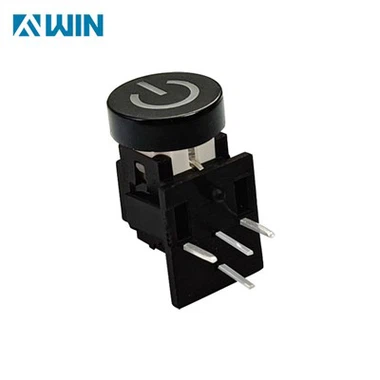
4. PCB (Printed Circuit Board) Mount Terminals
Description: These terminals are designed to be inserted into and soldered onto a PCB.
Application: Common in consumer electronics, where the switch is directly mounted onto a circuit board.
Advantages: Allows for compact and integrated design; simplifies assembly in mass production.
Disadvantages: Less flexible for field repairs; requires precise PCB design and soldering skills.
5. Wire Leads
Description: The switch comes with pre-attached wires, which can be directly connected to the circuit.
Application: Suitable for applications where the switch might be mounted away from the main circuit board or in a hard-to-reach place.
Advantages: Simplifies installation; no need for additional connectors.
Disadvantages: Fixed wire length can limit flexibility; connections might require additional securing methods like crimping or soldering.
Conclusion
Each terminal form of metal push button switches offers unique advantages and is suited for specific applications. The choice depends on factors such as ease of installation, maintenance requirements, and the intended use environment. Understanding these options helps in selecting the right switch for any given application, ensuring reliability and ease of use.