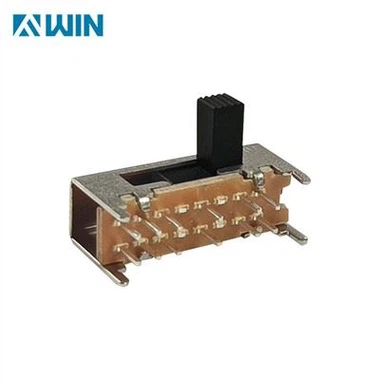
How does the DIP switches work
Apr 16, 2026
A standard surface-mount DIP switch consists of a set of fundamental two‑terminal electromechanical switches (capable of on/off or 1/0 states) housed in a thermally stable plastic enclosure. Although commonly called "jumpers" in general terms, they are technically a replacement for conventional jumpers, yet their core functionality is largely comparable.
The term "dual in‑line" describes the layout of the contact pins on the bottom of the DIP switch, which are designed for direct mounting onto a printed circuit board (PCB) or breadboard. These pins form two parallel rows beneath the switch package, giving rise to the name "dual in‑line". Typically, the total number of contact pins is twice the number of individual switches in the module.
DIP switches are ideal for applications where multiple switch positions must be adjusted to select specific device functions or output modes. A widespread use case is on computer motherboards, where various system and hardware configurations are set by switching each individual control to the appropriate position.
A standard DIP switch might consist of 1, 2, 4, 7, 8, 10, 16 or even more toggle, rocker, slide or rotary switches mounted into a single small block. Although they're simple components, the beauty of DIP switches is that having several toggles arranged in parallel means that each can be moved to 1/0 independently, potentially offering large numbers of different combinations to c
All the individual toggles in a single DIP switch array are electrically isolated from one another. When a toggle on a DIP switch is moved between its on/off positions, a flexible leaf spring underneath the switch responds to the movement of the slider or rocker, and bends slightly upward or downward in order to close or open a static contact below.orrespond with large numbers of possible device functions/outputs.
DIP switches are classified for specific roles and applications by their safe operational current, voltage and power ratings. It's important for users to observe and remain within the manufacturer's given specifications for a particular DIP switch, otherwise problems such as self-welded switches and electrical arcing during switching can occur, risking performance instability or device damage.