Mounting Options For Metal Push Button Switch
Aug 04, 2025
Metal push button switches offer several mounting options, each tailored to different application needs and environments. Here are two of the most common types:

Panel Mount
Panel mount is a prevalent option for metal push button switches. This method involves installing the switch through a pre - drilled hole in a control panel, instrument panel, or enclosure.
Installation Process: First, a circular or square hole is cut in the panel with a diameter or side - length that precisely matches the switch's mounting dimensions. Common hole diameters for metal push button switches range from as small as φ6 mm to as large as φ40 mm, depending on the switch model. After the hole is prepared, the switch is inserted from the front side of the panel. On the backside of the panel, a nut, locking washer, or a specialized retaining clip is used to secure the switch in place. This ensures a firm and stable connection, preventing the switch from moving or vibrating loose during operation.
Applications: Panel - mounted metal push button switches are widely used in industrial control panels, where operators need to interact with machinery controls. For example, in a factory's motor control center, panel - mounted push button switches can be used to start, stop, or reset motors. They are also common in the control panels of elevators, where reliability and durability are crucial. In addition, they find applications in the dashboards of vehicles, both automotive and aerospace, for functions such as activating emergency lights or controlling auxiliary systems. Their visibility and easy - to - reach location on the panel make them suitable for quick user interaction.
PCB Mount
PCB (Printed Circuit Board) mount is another important mounting option for metal push button switches. This is especially useful when integrating the switch directly into an electronic circuit board.
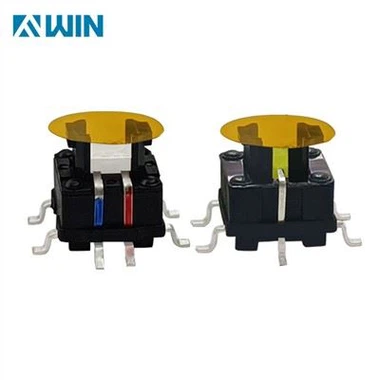
Installation Process: PCB - mount switches typically have pins or terminals that are designed to be soldered directly onto the pads on a PCB. There are two main types of PCB - mount configurations: through - hole and surface - mount. Through - hole switches have longer pins that pass through holes drilled in the PCB, and then the pins are soldered on the opposite side of the board. This provides a mechanically robust connection. Surface - mount switches, on the other hand, have shorter, flat - tipped terminals that are soldered directly onto the surface of the PCB using surface - mount technology (SMT). This method is more space - efficient and is often used in modern, compact electronic devices.
Applications: PCB - mounted metal push button switches are commonly used in consumer electronics, such as remote controls, where a small and lightweight switch is required to fit within a compact design. In medical devices, like portable diagnostic equipment, PCB - mount switches offer the advantage of being integrated directly into the device's circuitry, reducing the need for complex wiring and ensuring reliable operation. They are also used in small - scale industrial control modules and smart home devices, where space is at a premium, and the switch needs to be part of a highly integrated circuit board.