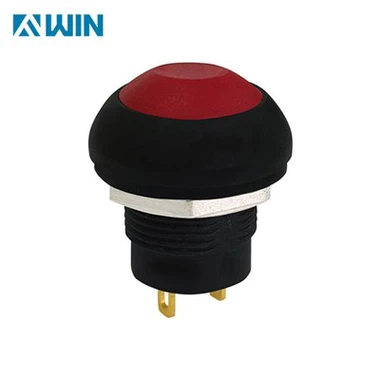
Can micro switches be used for momentary operation
Sep 12, 2025
Micro switches are highly versatile in terms of operational modes-they excel at momentary operation (the default behavior for most standard models) and can also support latching functions through specialized design or external circuitry. Their suitability for either mode depends on internal contact mechanisms and application requirements, rather than being restricted to one function. Below is a detailed breakdown of their capabilities, using examples tied to household and industrial use cases discussed earlier.
1. Default: Momentary Operation (Most Common for Standard Micro Switches)
Virtually all standard micro switches (including snap, mini, and miniature variants used in household appliances) are momentary switches by design. This means their contacts only maintain a closed or open state as long as an external actuation force is applied; once the force is removed, the switch reverts to its original "normal" state (normally open/NO or normally closed/NC) via an internal spring.
This behavior aligns with most micro switch applications, especially in household appliances and industrial controls. For example:
Household Appliances: The snap micro switch in a washing machine door lock operates momentary-closing the door applies force to actuate the switch (closing the NO contact to enable the motor), and opening the door removes the force (the switch springs back to open the contact, cutting power to the motor). Similarly, the mini micro switch in an electric kettle's "on" button is momentary: pressing the button actuates the switch to start heating, and the switch resets once the button is released (though the kettle's temperature cutoff may use a separate momentary micro switch to stop heating when boiling).
Industrial Use: A miniature micro switch in a conveyor belt's limit sensor acts momentary-when a product pushes the switch's lever (applying force), the switch triggers a signal to stop the belt; once the product passes (force removed), the switch resets, allowing the belt to restart.
Momentary operation leverages the micro switch's core advantage: its snap - action mechanism, which ensures fast, reliable contact closure/opening only during actuation-critical for safety (e.g., cutting power when an appliance door is opened) and precision (e.g., sensing object position).
2. Latching Operation: Achievable via Specialized Design or External Circuits
While standard micro switches are not latching by default, latching functionality can be implemented through two main approaches for applications requiring the switch to maintain its state without continuous actuation (e.g., toggling a light on/off with a single press):
A. Specialized Latching Micro Switches (Internal Design Modification)
Some manufacturers produce custom or specialized micro switches with an internal latching mechanism-typically adding a small mechanical latch (e.g., a detent or hook) that holds the contact in the actuated state after the force is removed. A second actuation (or a separate reset force) releases the latch, returning the switch to its original state.
These latching micro switches are less common than standard momentary models but are used in specific scenarios. For example:
A snap micro switch in a industrial control panel for a machine's "start/stop" toggle-one press latches the switch to start the machine, and a second press releases the latch to stop it.
A miniature latching micro switch in a smart thermostat's "hold temperature" function-pressing a button latches the switch to maintain the set temperature, and pressing again resets it.
Notably, latching micro switches retain the low - actuation force of standard models but sacrifice the automatic reset-making them suitable for applications where a persistent state is needed without continuous user input.
B. External Latching Circuits (Using Standard Momentary Micro Switches)
A more common way to achieve latching operation is to pair a standard momentary micro switch with an external electronic circuit (e.g., a flip - flop or relay). The momentary switch triggers the circuit, which then holds the desired state (on/off) until the switch is actuated again.
This approach is widely used in household and industrial electronics, as it avoids the need for custom latching switches. For example:
A household light switch that uses a standard momentary snap micro switch: Pressing the switch sends a momentary signal to a relay circuit, which latches to turn the light on; pressing again sends another signal, unlatching the relay to turn the light off.
A mini micro switch in a garage door opener: Pressing the button (momentary actuation) triggers a latching circuit that starts the door's motor; pressing again stops the motor-even after the button is released, the circuit maintains the "run" state until the door reaches its limit.
3. Key Considerations for Choosing Between Momentary and Latching Modes
When selecting a micro switch for a specific application, the operational mode depends on two core factors:
State Persistence Requirement: If the switch needs to maintain its state without continuous force (e.g., toggling a device on/off), latching (via specialized switches or external circuits) is required. If the switch only needs to act during force application (e.g., safety interlocks, position sensing), standard momentary micro switches are ideal.
Cost and Complexity: Standard momentary micro switches are lower - cost and more widely available than specialized latching models. Using an external latching circuit with a standard switch is often more economical than customizing a latching switch, especially for high - volume applications (e.g., household electronics).
4. Summary of Micro Switch Operational Modes
|
Operational Mode |
Default for Standard Models? |
Implementation Method |
Typical Applications |
|
Momentary |
Yes (all standard types) |
Internal spring - driven snap - action mechanism |
Appliance safety interlocks, position sensors, momentary buttons |
|
Latching |
No |
1. Specialized internal latching mechanism2. External latching circuits (relays/flip - flops) |
Toggle controls (light on/off), machine start/stop, thermostat hold functions |
In conclusion, micro switches are not limited to one operational mode-they are primarily designed for momentary operation (the default for standard snap, mini, and miniature models) and can also support latching functions through specialized design or external circuitry. Their flexibility makes them suitable for a wide range of applications, from safety - critical momentary interlocks in household appliances to latching toggles in industrial controls.