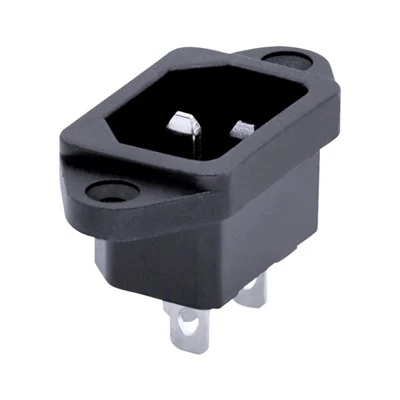
Ac Power Socket
ac power socket Description An AC socket, also known as an electrical outlet, is an essential component in any building's electrical system. It is designed to supply electrical power to portable electrical appliances and devices. AC sockets come in a variety of shapes, sizes, voltage ratings,...
Description

An AC power socket is an electrical component used to connect equipment to an alternating current (AC) power supply through a compatible plug. It is commonly installed in power supply units, industrial control cabinets, electrical enclosures, and electronic devices to provide an accessible power connection.
Depending on the application, AC power sockets are available in different standards, mounting styles, terminal configurations, and electrical ratings. When selecting a socket, equipment manufacturers should consider plug compatibility, rated voltage and current, mounting dimensions, and wiring requirements to ensure it fits the equipment design.
main features
1. Voltage rating: The voltage rating of an AC socket varies depending on the country of use.
2. Shape: The shape of an AC socket depends on the country of use.
3. Configuration: The configuration of the plug and socket determines the orientation and position of the live and neutral pins. Different countries have their own plug and socket configurations, which is why some plugs are flat or round, have two or three pins, or have a grounded pin.
4. Current rating: The current rating of an AC socket specifies the maximum amount of current that can flow through the socket without tripping the overload protection device. The current rating of a socket varies depending on the country of use and the application.
FAQ
Q: Your spec lists contact resistance ≤10 mΩ, same as others. What makes it different?
A: It depends whether 10 mΩ is just the upper limit or the typical range. Many lots cluster at 8–10 mΩ with little thermal margin. Our typical range runs 6–8 mΩ; silver‑riveted contacts stay ≤6 mΩ. Check resistance distribution or thermal test reports instead of only the spec value to judge lot consistency.
Q: Silver‑riveted contacts vs standard tin‑plated terminals, which to pick?
A: Tin plating works fine if your unit runs under 60% rating with good cooling. Choose silver rivets for steady 10 A near full load, sealed enclosures, long warranty or high service cost. Match your selection to load and cooling, not just go for the premium option.
Q: Can rivet quality be checked visually?
A: Visual inspection helps but is not enough. Good rivets show even indentation without flaring or cracks around silver spots. Solder reinforcement near rivets often signals unstable riveting. Batch records for rivet pressure, indent depth and contact resistance testing are more reliable.
Q: Can you supply full‑load temperature rise test data?
A: Yes, we provide measured terminal temperature rise at 10 A with samples. Results vary by ambient temperature, mounting and wire size. These figures are for your design reference and do not replace full equipment thermal certification.
Q: Are retention force and contact resistance conflicting?
A: Careful balance is required. Too much riveting hardens pins, reduces spring tension and may pull the withdrawal force below the IEC 60320‑1 minimum of 10 N. We test every unit for contact resistance and sample batches for withdrawal force to keep both within limits.
Hot Tags: ac power socket, China, suppliers, manufacturers, factory, customized, wholesale, for sale, made in China, ac outlet types, ac power plug socket, ac power socket with fuse, ac power socket with fuse and switch, c14 inlet socket, power plug socket for ac